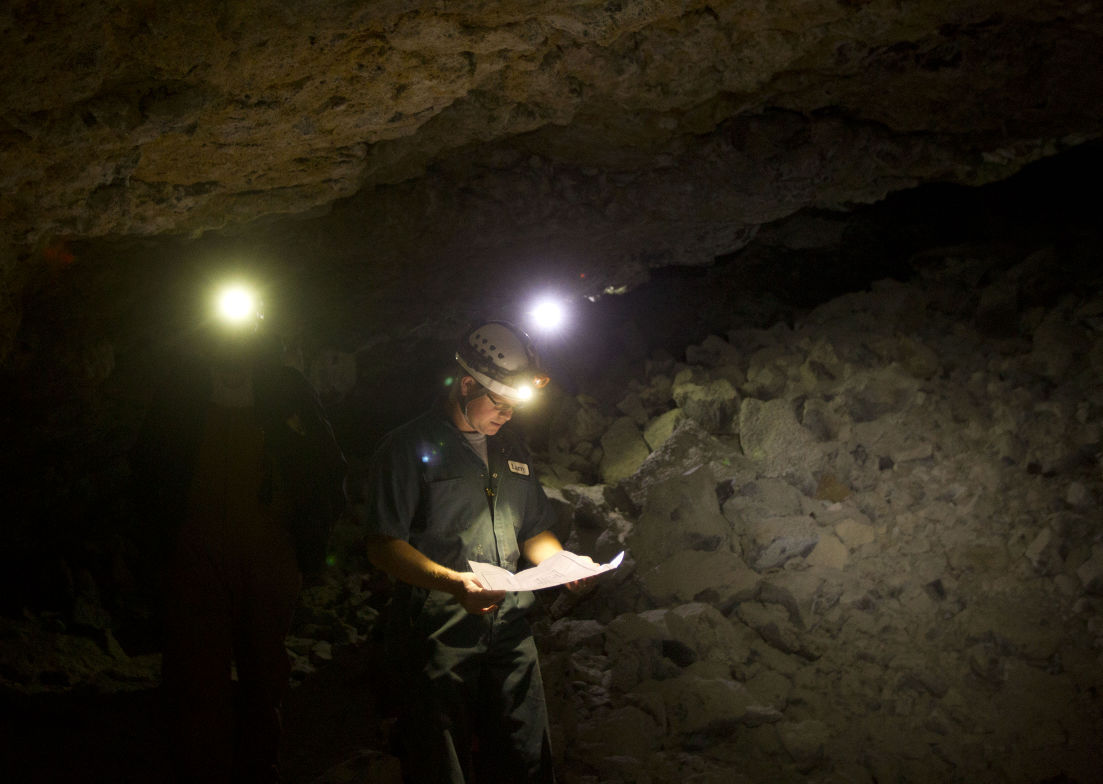
Beware: You should never explore wild caves alone or without proper gear. Consider getting in touch with a Grotto of the National Speleological Society at www.caves.org or a qualified cave club. These groups are skilled and will train you. Without sufficient knowledge, preparation, and equipment, cave exploring can lead to serious injury or death.
A headlamp that works well on a trail can fail in a cave. There is no ambient light underground to fall back on. Water is constant, mud gets into every seam, and a trip planned for four hours can run to seven.
Most headlamp guides rank lights by maximum lumens. That number means very little underground. Almost no lamp holds its maximum for more than a few minutes before heat forces it down. What matters is what your lamp will still be doing in hour five.
One lamp is not enough
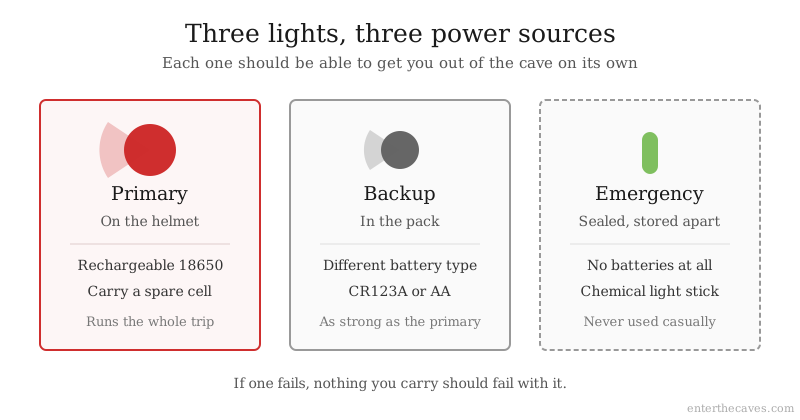
Before any specific model is worth discussing, the count matters more than the brand. The standard in caving is three independent light sources. Each one should be able to get you out of the cave on its own.
Switchback Travel, which tests headlamps in the field, states the rule plainly. Carry a primary. Carry a backup at least as powerful as the primary. Carry a third emergency light on top of both.
There is a reason cavers are strict about this. If your only lamp fails underground, you have no way to see and no way to move safely. Lamps get dropped. Battery compartments flood. Cold drains batteries faster than most people expect.
So the question worth asking is which lamp does which job.
What makes a lamp cave-worthy
Waterproofing, and why two digits matter
IP ratings describe protection against solids and liquids. The first digit covers dust. The second covers water.
IPX6 means a lamp survives powerful water jets. IP68 means it is dust-tight and rated for sustained submersion. In a cave with standing water or stream crawls, that difference decides whether your lamp survives the trip.
The rating is also more conditional than the packaging suggests. Fenix documents that the HM65R-T V2.0 is IP68 with its charging port cover closed, and IP66 with the cover open. A rubber cover knocked loose in a squeeze quietly downgrades the lamp, and you would not find out until water was already inside. Check the port seal before every trip, the same way you check a battery.
Sustained output beats peak output
Every lamp here advertises a turbo mode. Almost none of them hold it for long. The Nitecore HC33 runs 1,800 lumens for thirty minutes. The Fenix HM50R V2.0 holds 700 lumens for one hour. Those figures come from the manufacturers, and they describe a short burst.
A realistic caving working level sits between 130 and 400 lumens. That is enough to move confidently and handle rigging at your hands. Judge lamps at that level and the differences get stark. At 400 lumens the HM65R-T V2.0 is rated for twelve hours. The HM50R V2.0 at the same output is rated for three.

Beam shape
Caving asks two things of a beam. Flood is a wide, even spread that lights the rock under your hands in a crawl. Spot, also called throw, is a focused beam for reading a passage ahead.
A lamp that only throws gives you a bright hot center with darkness around it. That is the wrong shape for close work on wet rock. It also explains why long-range versions of otherwise good lamps make poor caving choices. Distance is rarely your problem underground.
Batteries you can swap
A sealed rechargeable lamp cannot be revived mid-trip. A lamp taking a removable 18650 cell can, provided you carry a spare.
Some models accept CR123A primaries as a fallback, usually at reduced output. The HM50R V2.0 caps at 130 lumens on CR123A. The HC33 loses turbo entirely.
Lithium cells also lose capacity in cold. Most caves sit well below comfortable air temperature all year, while manufacturer runtimes are measured at room temperature. Plan for less than the box promises.
Tint
Nitecore’s product documentation says warm light around 3000K cuts through fog and rain more effectively and is easier on the eyes. Cool white at 6500K is intended for open outdoor visibility.
Caves carry suspended moisture almost constantly, from breath fog to spray near moving water. A warm or neutral option is worth having. Treat this as something to consider, though. It is a general optical principle, and we have not found a source establishing it specifically for cave conditions.
How these are scored
The scores below are arithmetic. They are not test results. Nobody at this site has taken these lamps underground, and every figure feeding a score comes from a manufacturer specification sheet.
The weighting is sustained runtime at a usable output 30%, water and dust rating 25%, beam pattern 20%, weight on a helmet 15%, and battery system 10%.
That weighting reflects caving priorities. A bright, light, short-running lamp will score below a heavier one that lasts. Scores also assume the lamp is your primary. A low score here can still be the correct backup, and one of them is.
| Lamp | Working output (rated runtime) | Water rating | Score |
|---|---|---|---|
| Fenix HM65R-T V2.0 | 400 lm (12 h) | IP68 with port cover closed; IP66 open | 8.7 |
| Nitecore HC33 | 240 lm (5 h 15) | IP68, 2 m submersible | 7.0 |
| Fenix HM61R V3.0 | 600 lm (5 h 45) | IP68, not dive rated | 6.7 |
| Fenix HM50R V2.0 | 400 lm (3 h) | IP68 | 6.2 |
Fenix HM65R-T V2.0: the strongest primary here

Twelve rated hours at 400 lumens earns the Fenix HM65R-T V2.0 its position. Nothing else on the list comes close.
It runs a cool white spot LED alongside a warm white flood at 3000K. One lamp covers both beam jobs, and you can switch tint as conditions change.
The body is magnesium alloy, rated to two meters of impact. Sealed, it is IP68 at two meters submersion for four hours. It takes a 3400 mAh 18650 cell and will also run on two CR123A primaries.
At 145 g with battery and headband it is heavier than the alternatives, and you will feel that on a helmet after several hours. Fenix markets it for trail running. That is a marketing choice, and the specification meets caving requirements either way.
Nitecore HC33: wide beam, short top end

The Nitecore HC33 has one clear advantage, and it is the beam. It spreads to 100 degrees, and a diffuser comes in the box, which helps in a crawl. It is IP68 to two meters and takes an 18650 or two CR123A cells. It also detaches from the headband to work as a right-angle flashlight.
Two things to know before buying. Turbo needs an 18650 cell capable of at least 8 A continuous discharge, so an ordinary cell will not reach the advertised output. Many listings also ship without a battery, which makes the headline price misleading.
Fenix HM50R V2.0: the backup

The Fenix HM50R V2.0 finishes last as a primary and is still the one worth buying second. At 78 g with battery and headband, carrying it costs you nothing. That is exactly what a backup needs. A backup you leave at home because it is bulky will not help you.
The HM50R is IP68 and impact rated to two meters. It detaches for handheld use and has a red mode rated at 60 hours.
Its limitation is the small 16340 cell. You get three hours at 400 lumens, and CR123A fallback caps output at 130 lumens. As a light that lives in your pack and gets you out of a cave, that is enough.
Fenix HM61R V3.0: capable, wrong balance

On paper the Fenix HM61R V3.0 is the most versatile lamp here. It gives you an 1,800 lumen spot, a separate flood, three red levels, and a 4,000 mAh cell. It detaches into a right-angle flashlight with a magnetic tail cap. Fenix describes it as built for industrial use.
The flood is where it falls down. It tops out at 200 lumens for a rated two hours, which is thin for the beam a caver uses most.
At 167.6 g with battery it is also the heaviest option here. A proximity sensor is enabled by default and can dim the lamp when something comes close to it. In a squeeze that is the opposite of helpful. You can turn it off, and you should.
The lamps that are missing from this list
The two brands most associated with caving are hard to find on the general retail market. Leaving that unsaid would give you a misleading picture.
Petzl’s DUO line is purpose-built for caving. The battery pack sits at the back of the head to balance the weight, helmet mounting plates are included, and an anti-glare function dims the beam automatically when two lamps meet, so a group can face each other without blinding anyone.
The DUO S is the current rechargeable model, rated at 1,100 lumens in boost. The battery-powered DUO Z2 has been discontinued. Neither is reliably stocked by general retailers, and this site earns no commission on either. You will find them through caving specialists such as Karst Sports or Inner Mountain Outfitters.
Armytek’s Wizard line is also well regarded, and we have reviewed the Wizard C2 Pro separately. The version currently easy to find is the C2 Pro Max LR. Its long-range optic is built for 181 meters of throw, which is the wrong tool for a passage.
The third light
Your emergency light does not have to be impressive. Its job is to work when the other two have already failed.
That means it should share as little as possible with them. Use different batteries where you can. Store it separately. Keep it out of casual use so it is never flat when it matters.
Chemical light sticks fill this role for many cavers. They cannot fail electrically and they need no power source, though you cannot switch one off once it is cracked. We have covered how light sticks work and what to look for separately.
Before you buy any of this
Gear is the smallest part of caving safely. No article is preparation for going underground.
If you have not caved before, start with a grotto. That is a local chapter of the National Speleological Society. A qualified cave club works just as well. They run trips, they train people, and they will lend equipment to newcomers.
That is also the honest answer to which lamp to buy first. Go underground with people who know the cave, borrow a lamp, and see what you reach for.